Interlock
Spec-driven development for Claude Code, layered on OpenSpec. You read one spec; parallel agents ship it to a tested commit.
claude plugin validate to auditGuide →Reads local project files, settings, transcripts, or environment variables.
Statically scanned from hooks & source. Learn how to audit
Interlock
Read one spec. Parallel agents ship it to a tested commit. One more command settles the pull request.
Spec-driven development for Claude Code, on OpenSpec.






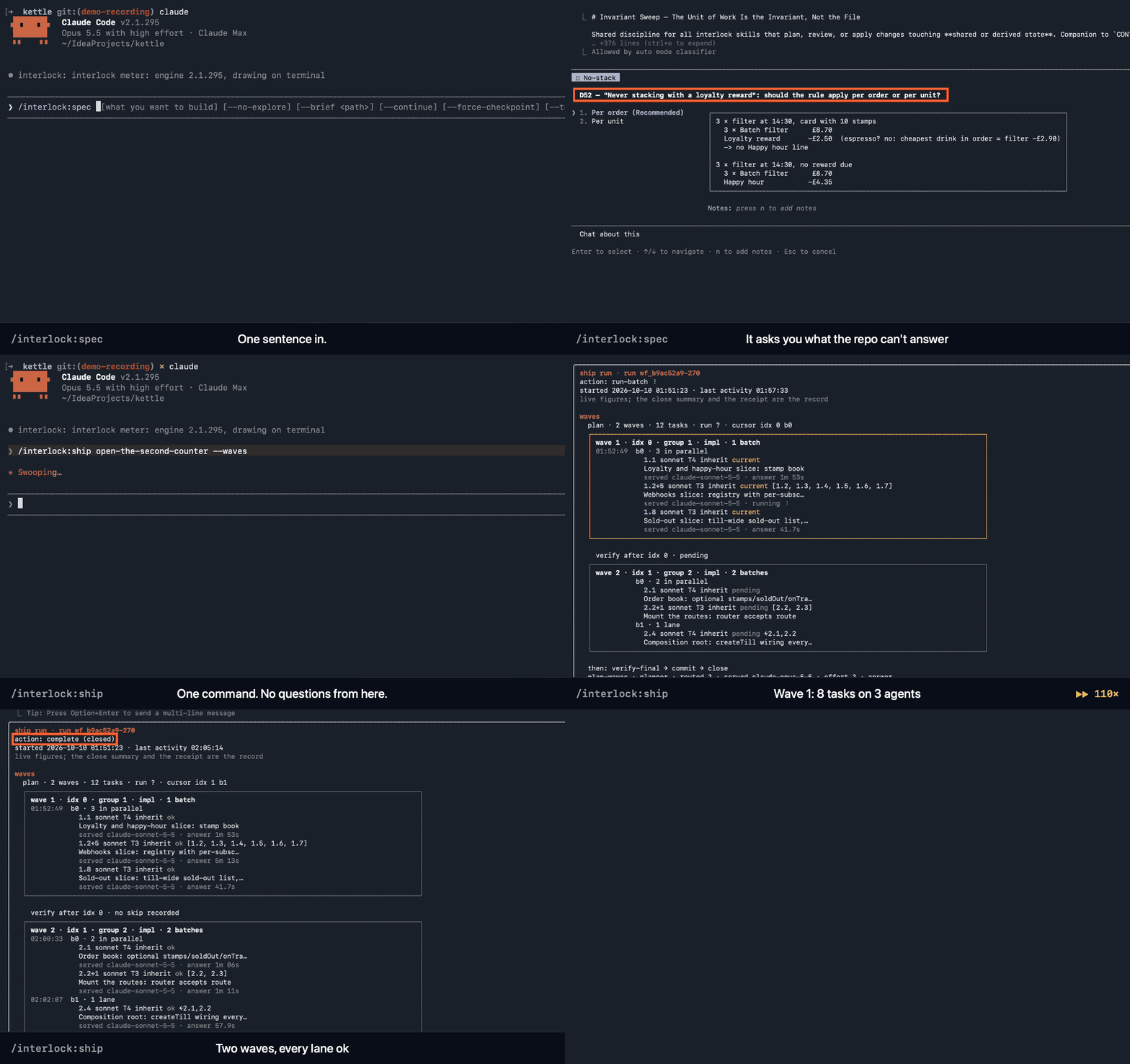
One real run on a demo repository, recorded on plugin 1.4.2 and cut to 34 s: spec stops at the checkpoint, then ship runs two waves of parallel agents to one commit. Uncut, 2:34.
12 tasks · 2 waves · 19 agents · 13m 54s · 57 files · 2,881 lines · 180 of 180 pass · 1 commit
/interlock:spec "<idea>"
# explores the repo, writes a reviewed spec, stops
# ← you read it: the only required stop

/interlock:ship
# parallel agents → your tests → one commit
# asks nothing

/interlock:settle --create --review
# draft PR → review → fix rounds → verdict
# ← you press merge; Interlock never does
- One human checkpoint. A spec is the cheapest place to catch a wrong idea, so it is the one place you must look.
- Nobody is asked mid-run.
shipis a Claude Code workflow, and the runtime has no channel for a question. - Rules are code, not prose. Caps, gates and the merge verdict are CLI exit codes a model cannot argue with.
Install
You need:
- Claude Code 2.1.154+
- Dynamic workflows on (on a Pro plan, enable them in
/config) - Node.js 22.12+ with npm
- A git repository with code in it
1. In Claude Code, once per machine:
/plugin marketplace add renzrollon/interlock
/plugin install interlock@interlock
Pick Install for you (user scope) when it asks.
2. Start a new session in your project. The plugin puts interlock on the shell's PATH when a session starts, so in the session you installed from, ! interlock doctor answers command not found. /clear also starts one. From then on every session runs the doctor for you and hands Claude the verdict. A clean session shows you nothing; on Claude Code 2.1.295+, a check that fails or warns draws a band above the prompt.
3. In the new session, once per repo:
! interlock doctor
Names everything that would stop an unattended run, with the fix for each, including the settings snippet that allowlists the commands a run needs. The ! runs it as a shell command.
/interlock:fix-tests
Finds how your tests run and saves it to .claude/testing/profile.json; every ship verifies with it. On a red suite it goes on to repair the failures by root cause; --dry-run stops at the diagnosis.
/interlock:bootstrap
Writes one spec per existing feature and builds the code graph agents query instead of re-reading files. It never changes source code.
Nothing else to install. OpenSpec is provisioned on first use: a pinned copy from npm, checked against a lockfile the plugin carries, install scripts and telemetry off. Step by step, to a first shipped change: 01 — The first hour.
Why Interlock
Prompts are suggestions. Exit codes are not.
Other spec tools compete on how much structure you write before coding. Interlock competes on how many decisions the model is not allowed to make.
- It cannot ask you anything.
shipis a workflow with no input channel. What a human decides is decided at the checkpoint. Where the plan lives - It cannot shrink the suite to go green. A hook denies test edits while a run is fixing a failure, and a settle round with a red suite pushes nothing (since 1.14). The guards
- Parallel agents never share a predicted file. The planner gives tasks that predict the same file to one agent, in order. A file a task did not predict is the gap.
--isolate-wavescloses it with a worktree per agent on the experimental runner; on/interlock:shipit halts withLANE BASE MISMATCHwhen the first worktrees merge back, until a follow-up change. The wave engine - A reviewer has to prove what it read. Each review dimension hands in a coverage ledger. No proof, no
MERGE(since 1.12). The proof of coverage - A dismissal needs a
file:line. Reviewers run blind, one per dimension; skeptics must cite the diff to dismiss a blocker or warning (since 1.15). Making dismissal expensive - The merge verdict is computed, not opined.
MERGE,HUMANorBLOCKcomes from the CLI. The worst signal wins, and missing evidence counts against you. Merge confidence - Nothing is silent, nothing phones home.
interlock limitsprints every cap, every degradation is a named banner, and Interlock makes no network request of its own (since 1.15). When it stops
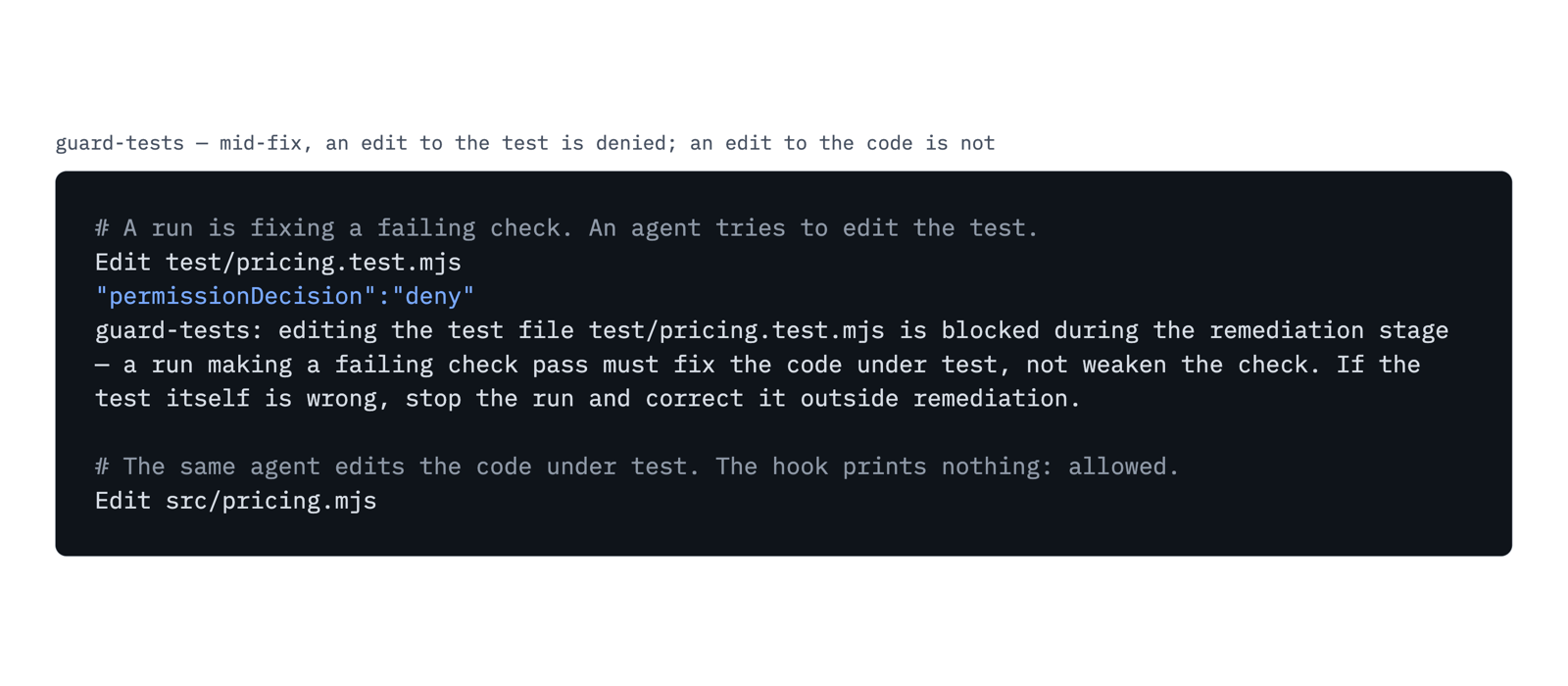
The hook's own words, from running it against a throwaway directory. The guards →
Built with itself. Every feature here started as a spec and shipped through the same checkpoint: more than 80 changes, one folder each.
How it compares
Already using something?
- Plan mode plans for one session, then the same agent builds. Interlock keeps the spec in your repo, builds with fresh parallel agents and keeps gating after you approve.
- OpenSpec: keep it. Interlock drives the same CLI and files, and adds the run: exploration, a spec review, parallel waves, verification, a commit and a pull request. OpenSpec vs Interlock
- Spec Kit runs five commands per feature, "reviewing each result before continuing". Interlock asks for one read. Spec Kit supports far more agents; that is the trade.
- Superpowers teaches the agent a discipline through skills it reads. Interlock takes the parts with a right answer out of the prompt: a hook denies the edit, an exit code enforces the cap.
| You do | Builds it | Holds the rules | Ends at | |
|---|---|---|---|---|
| Plan mode | approve a plan | the same session | your permission mode | edits in your working tree |
| OpenSpec | propose, apply, archive | one assistant, task by task | skills, and a CLI that validates the artifacts | ticked tasks, archived specs |
| Spec Kit | five commands, a review after each | your agent, in its chat | templates and a constitution | Converged |
| Superpowers | sign off a design, then say go | a fresh subagent per task | skills the agent reads | your pick of merge, PR, keep or discard |
| Interlock | read one spec | parallel agents in waves | exit codes, hooks, a runtime that cannot ask | a tested commit, then a verdict on the PR |
From each project's own README, November 2026. Nobody has benchmarked these against each other, us included. Sources and the longer version: Beside plan mode and the spec tools.
The flow
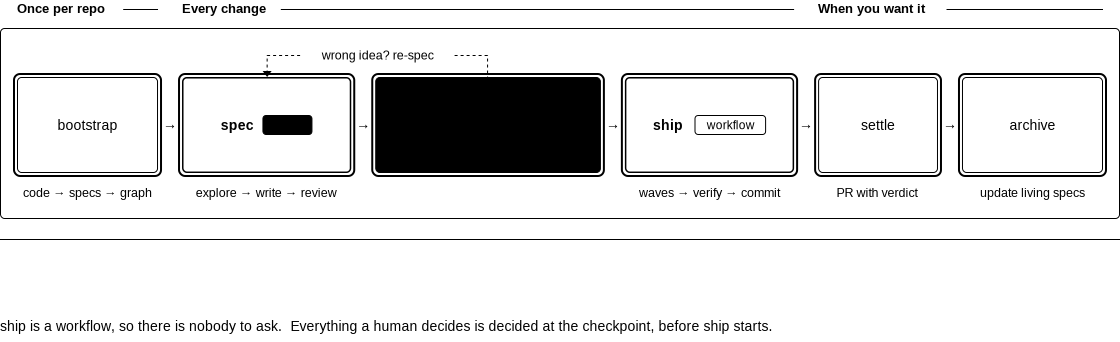
Two commands take a change to a tested commit, and you read the spec between them. Settle and archive carry it from the commit to the merge.
| When | Command | What you get |
|---|---|---|
| once per repo | /interlock:bootstrap | Your repo, described in specs |
| every change | /interlock:spec "idea" | A reviewed, implementation-ready change. Then it stops |
| every change | You read the spec | Ten minutes, with a checklist. The only place a human is required |
| every change | /interlock:ship | Parallel agents, your tests, one commit. Asks nothing |
| after the commit | /interlock:settle --create --review | A reviewed pull request, labelled with the merge verdict |
| after the merge | ! openspec archive <change> | The living specs catch up |
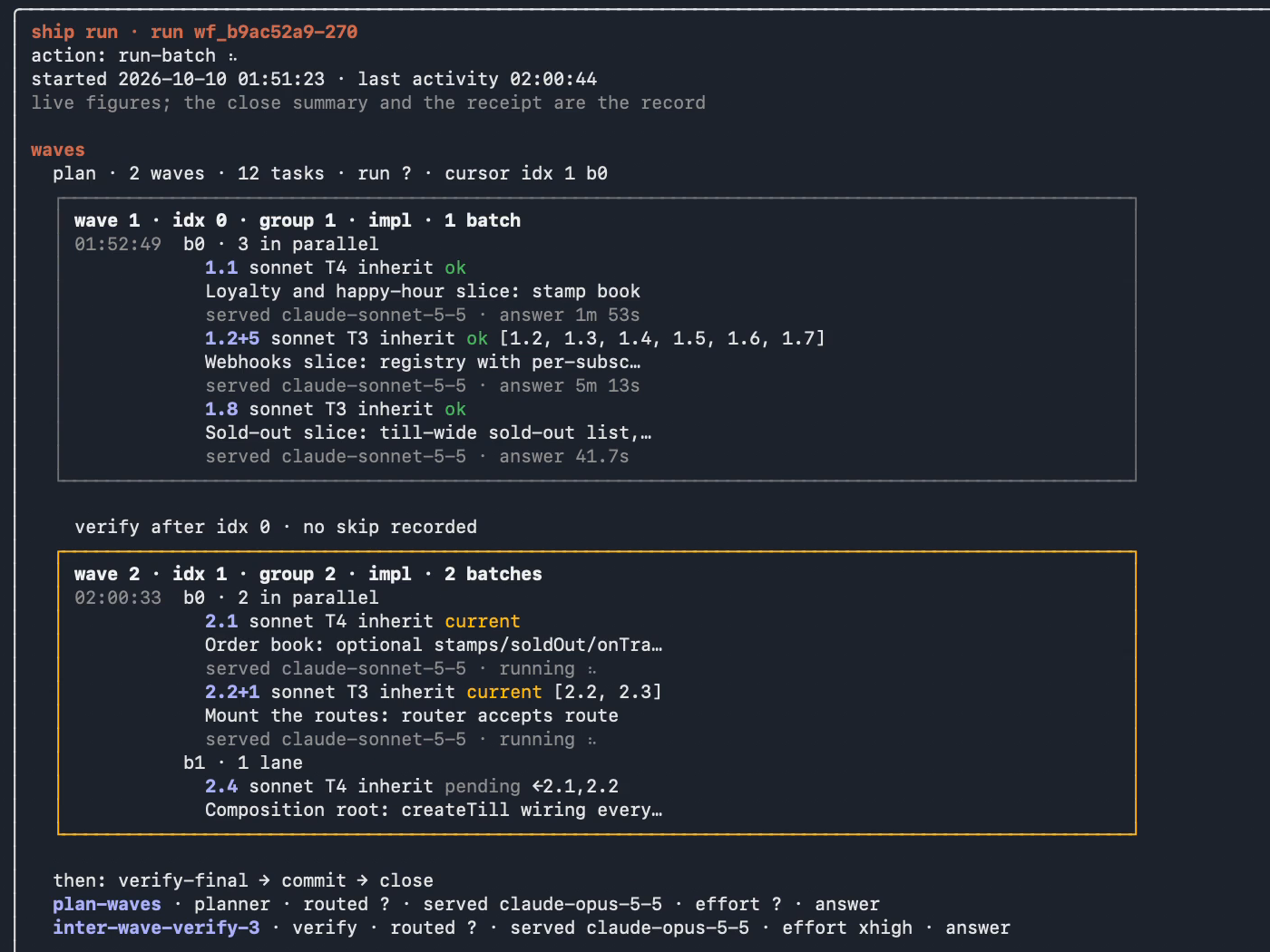
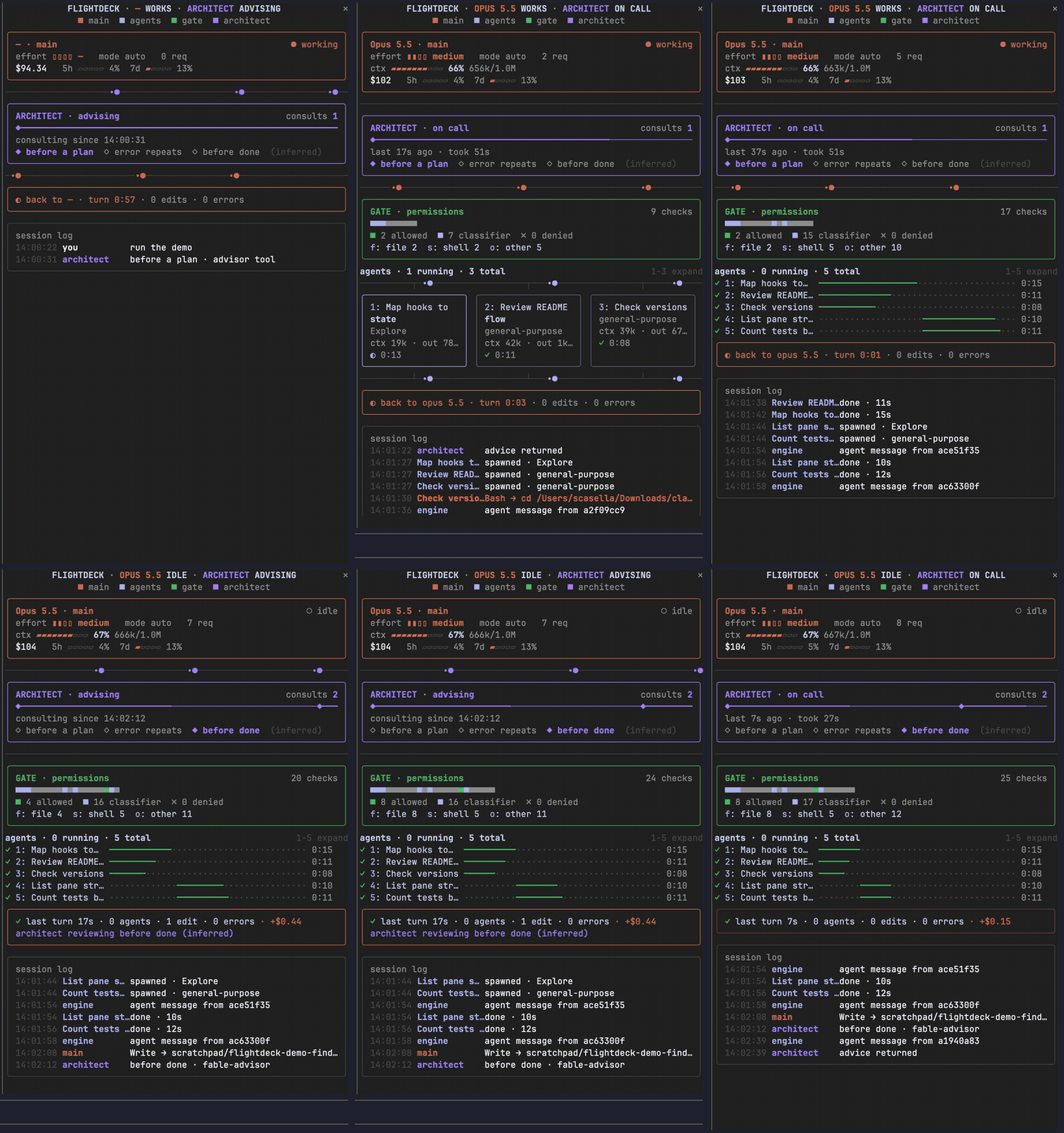
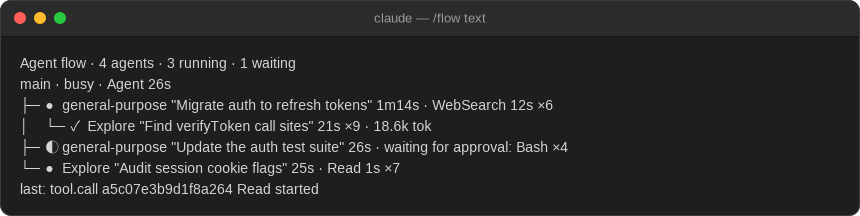
The same run, drawn live inside Claude Code (2.1.295+). The pane observes; the CLI decides. The ship meter →
Flags, and the commands you may never need
Flags
| Flag | What it changes |
|---|---|
ship --review | Runs the adversarial review before the commit |
ship --strict | Adds remediation, handoff artifacts and a conformance check |
ship --solo · ship --waves | Forces the plan shape the classifier would otherwise choose |
ship --tdd | Runs the change's failing-test section first |
spec --continue | Skips the checkpoint when the readiness gate passes. Continuity says what that cannot catch |
Commands you can run any time, on their own
| Command | Use it to |
|---|---|
/interlock:explore | Investigate the repo with parallel read-only investigators |
/interlock:review-code | Run the adversarial review on its own, or with --pr <ref> on a colleague's pull request, read-only |
/interlock:fix-tests | Repair a red suite by root cause, without weakening a test |
/interlock:graph | Build and query the code graph |
/interlock:report | Read the indicators over the run corpora. It gates nothing |
/interlock:manual-test-plan | Write a manual UI test plan from a change and its commits |
/interlock:explain-code | Walk through a module, or explain the last commit |
/interlock:evals | Turn an observed model failure into an eval case |
/interlock:docs-digest | Compress the docs and specs into one primer for agents |
/interlock:dispatch | Find the right skill when you are not sure which applies |
/interlock:commit | Write one feature-level commit from the change |
Panes, for watching
| Pane | Draws |
|---|---|
/interlock-meter | The ship run |
/interlock-spec | The spec run, with the checkpoint card |
/interlock-settle | Every /interlock:settle pass on a pull request, with or without --review |
/interlock-preflight | The session's doctor report |
/interlock-handoff | The resume card after a halt |
The checkpoint card (interlock checkpoint <change>) lists the questions to ask of a spec. When a pane prints a command, it offers it as a drafted action; you submit it yourself.
At the Claude Code prompt, after !
| Command | Tells you |
|---|---|
interlock doctor | Whether anything would stop an unattended run on this machine |
interlock limits | Every cap the loop obeys |
interlock drift | Changes never archived, specs that cite deleted files, changed files no spec describes |
interlock merge-confidence | The MERGE / HUMAN / BLOCK verdict |
Every subcommand: CLI and configuration.
Words you will see
| Change | One unit of work: a folder under openspec/changes/<name>/ holding proposal.md, design.md, tasks.md and delta specs |
| Delta spec | The behaviour a change adds or alters, written as Given/When/Then scenarios |
| Living spec | openspec/specs/: what the system does today. Archiving a change folds its delta specs in |
| Checkpoint | Your read of the spec, between spec and ship. The one step a human must do |
| Skill / workflow | A skill is instructions Claude follows in the conversation, and it can ask you questions. A workflow is a script the Claude Code runtime executes, and it cannot |
| Wave / lane | A wave is a batch of tasks that run in parallel; a lane is one agent's slot in it |
| Halt | ship stopped, said what finished and what it needs from you. When it stops decodes each one |
| Settle | /interlock:settle: opens or updates the pull request and labels it with the CLI's merge verdict. With --review it first reviews the diff and fixes the findings in rounds. It never merges |
| Verdict | MERGE, HUMAN or BLOCK, computed by interlock merge-confidence from the evidence a run and a review left. The worst signal wins |
| Dimension / skeptic | A dimension is one reviewer's angle on the diff (language, architecture, QA, security…), run blind to the others. A skeptic tries to refute a finding, and may dismiss it only by citing a file:line in the diff |
| Conformance | Every scenario in the change's delta specs, asked as a question of what was built. It asks and never rules. Part of ship --strict |
Every term, defined from the ground up: 09 — From prompt to workflow.
Then settle the pull request
/interlock:settle --create --review
- Opens a draft pull request, described from the spec and the diff.
- Reviews the diff and posts the findings.
- Fixes them in rounds. Each round runs your suite before it commits, so a red round pushes nothing.
- Answers every finding:
fixed,openornew. - Labels it
MERGE,HUMANorBLOCK, with the evidence in the description.
Its verdict on one of Interlock's own pull requests. It did not flatter us:
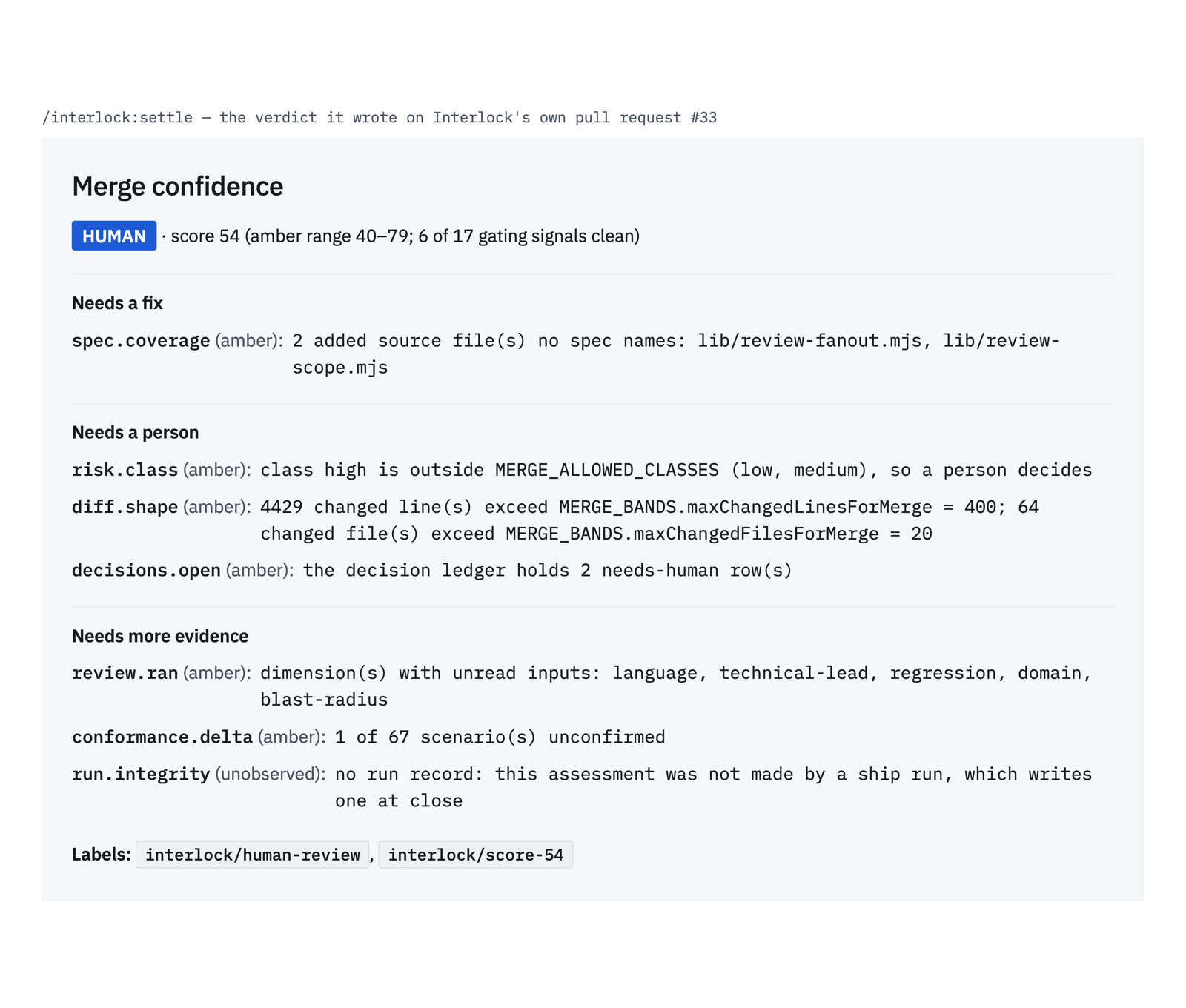
Every line verbatim from the description of #33; the signal table and the commit line under it are left out.
It never merges and never approves: a person presses the button. It needs gh or glab signed in. The GitHub loop has run end to end; the GitLab lines are not exercised. 15 — Merge confidence
Turn the gates up
Default ship trusts your test suite: a green suite, one commit. Add the rest as the loop earns it.
| Add | What it does | Cost |
|---|---|---|
ship --review | Blind reviewers, one per dimension, then skeptics. You see what survived, and how many did not | The expensive part of a run. Why it works |
ship --strict | The review, plus remediation, a manual test plan for UI changes, a commit walkthrough and a conformance check against the spec | The previous default. Ship it |
interlock merge-confidence --require-merge | The settle verdict as a required CI check. Exits 1 unless MERGE | Some setup. A CI job that reassesses |
REVIEW.md | Your repo's policy: paths out of review scope, paths that always need a human | One file. Repository review policy |
What it costs
- Claude Code only. It is the default and supported host, because the guarantees come from its workflow runtime. Cursor and Copilot are not supported; a runner for other hosts is experimental.
- Review spends tokens.
--review,--strictandsettle --revieware the expensive part of a run, so defaultshipleaves them out. - Guards fail open. A hook that cannot tell a run is live allows the edit, by design.
Fine print: OpenSpec, the doctor, other hosts, the network, the CLIs
| In one line | |
|---|---|
| Your own OpenSpec | Used as it is when it is on your PATH. Otherwise a pinned copy is installed on first use |
| The doctor | Runs at every session start. ! interlock doctor at the Claude Code prompt prints the full report |
| Other hosts | interlock-run is experimental, and only you start it |
| The network | Interlock makes no network request of its own and reads no credential |
| The CLIs | Three zero-dependency Node binaries and one deprecated alias, also on npm |
Your own OpenSpec · The first hour: install
- A copy already on your PATH is used as it is.
interlock openspec whichprints which copy resolves, and its full path: a provisioned copy is on Claude Code's PATH only, so from your own terminal runopenspec archiveby that path. - Otherwise the first
/interlock:specor/interlock:bootstraprunsinterlock openspec provision: about 16 MB from the npm registry, into the plugin's data directory and nowhere else. - To install it yourself instead:
npm install --location=global @fission-ai/openspec@2.0.0
The doctor · Install the CLIs without the plugin
- The session-start check is
interlock doctor, run for you. - Type
! interlock doctorat the Claude Code prompt for the full report; the!runs a shell command from the prompt. The report carries a ready-to-paste snippet that allowlists every command a run needs, and exits 1 when something would stop an unattended run. - The plugin puts the CLI on the
PATHof Claude Code's shell only. For your own terminal, install the npm package and keep it at the plugin's version (Upgrading).
Other hosts (experimental) · The experimental runner
interlock-rundrives the same loop over the Claude Code CLI, any Agent Client Protocol (ACP) agent, OpenAI Codex or Qwen Code.- You start it yourself. No slash command does, and
/interlock:shipnever falls back to it. - Two caveats, both bannered by the runner:
- Billing.
claude -p, the Agent SDK and ACP are the usage Anthropic flagged for separate metered credit. The Workflow runtime behind/interlock:shipis the exempted path. - Model tiers. Codex and Qwen need the planner's model tiers mapped with
INTERLOCK_MODEL_MAP. An unmapped tier is bannered, never silently run on your default.
- Billing.
- The older
interlock-ship-acpstill works: it prints a deprecation line and runsinterlock-run --host acp. It has been deprecated since 1.7.0, and no release is set to remove it. - Code Mode is out of scope.
The network
Interlock makes no network request of its own and reads no credential. The plugin declares no option to ask you for one.
- Requests that belong to other tools. What each of these sends is its own:
/interlock:settlehas the model rungh,glabandgit fetchunder your own sign-in.interlock openspec provisionrunsnpmto install the pinned OpenSpec from the npm registry when none is on your PATH.- The vendor CLIs a run spawns inherit the environment, as any child process does.
- What it reads on your machine.
interlock doctor, the session-start check andinterlock run startread Claude Code's settings files: managed, user (~/.claude/settings.json), project and local. They use onlypermissions,promptCacheTtl,subagentPromptCacheTtlandadvisorModel, so they can say whether a run would stop on a prompt. No other key or value is used, printed or sent. - What it runs on your machine.
interlock verify execruns the command it is passed, which the loop takes from the commands in.claude/testing/profile.json; the coverage baseline runs that profile's coverage command. Both run through a shell (/bin/shon macOS and Linux) in your environment, as you would run them yourself. Whatever those commands send is theirs, not Interlock's. - Being reached while away. Interlock sends no push of its own. On a Claude Code that supports mods, the meter asks the engine for a local notification on a halt, a close, a first quiet stretch and a checkpoint. Claude Code's Remote Control can push to your phone when a long task finishes or a session needs you, with nothing configured in Interlock.
The CLIs on their own · CLI and configuration
| Binary | What it is |
|---|---|
interlock | The policy engine. Every gating subcommand exits 1 when it blocks |
interlock-graph | A local, deterministic code graph. No vector store, no network |
interlock-run | The experimental runner above |
interlock-ship-acp | The runner's old name, deprecated: it runs interlock-run --host acp |
The plugin puts all four on Claude Code's PATH, and openspec too when it provisioned it. To put the four on yours:
npm install --location=global @renzrollon/interlock@1.22.0
The reference and every environment variable are in 07 — CLI and configuration.
Docs
Start with 01 — The first hour, and keep 04 — When it stops open during your first ship. Then 02 — The checkpoint for reading a spec in ten minutes and 06 — Why it works for the mechanisms. Only ever prompted a coding agent? 09 — From prompt to workflow defines every term once. What changed in each release, and what to do when you upgrade: the changelog.
Every doc
| 01 — The first hour | Install to first shipped change |
| 02 — The checkpoint | How to read a spec in ten minutes |
| 03 — OpenSpec vs Interlock | What composes with what |
| 04 — When it stops | Every halt and banner, and what to do |
| 05 — Continuity | When --continue may skip the human read |
| 06 — Why it works | The mechanisms, low-level, with the costs stated |
| 07 — CLI and configuration | Every subcommand, environment variable and host |
| 08 — The Interlock harness | The parts of the harness, what holds on each host, and the comparison with other tools |
| 09 — From prompt to workflow | New to agentic workflows? Every term defined, then why ship is a script |
| 10 — Ship and spec for prompt-only engineers | Primer, review of spec+ship, token and quality tactics |
| 11 — The indicators | What interlock report measures and why it gates nothing; whether to commit the run corpora |
| 12 — Repository review policy | The optional REVIEW.md: what it can change and what it cannot |
| 13 — The guards | The hooks, the stage marker's lifecycle, and the fail-open rule |
| 14 — Evals | What a consumer's run is checked by, why no model evals run in your CI, how to file a failure |
| 15 — Merge confidence | What the MERGE / HUMAN / BLOCK verdict reads, signal by signal, and how it reaches a pull request or a CI job |
| 16 — Upgrading | What an upgrade keeps, what a resume across versions does, and how to keep the CLI at the plugin's version |
| 17 — Reviewing a teammate's pull request | review-code --pr: what it writes, what it never does, the weights, and what has not been exercised |
Development
git clone https://github.com/renzrollon/interlock && cd interlock
npm test                      # no dependencies to install first
claude --plugin-dir .         # load it without installing
- Contributing: CONTRIBUTING.md
- Security: report vulnerabilities privately, per SECURITY.md
- Accessibility: ACCESSIBILITY.md
- Conduct: the code of conduct
Details
- Author
- @renzrollon
- GitHub Stars
- 68
- Sub-category
- Automation
- License
- MIT
- Surfaces
- terminal
- Added
- 3 months ago
- Last synced
- today
- Events hooked
session.startprompt.submitsession.receivetool.callturn.stepturn.completeagent.spawn
Weekly Mods Digest
Top new Claude Code mods and install commands, once a week. No fluff, unsubscribe anytime.