Agent Usage Guard
A Claude Code mod that holds subagent fan-out, heavy-context prompts and retry loops before they spend your usage window. It reads your plan's usage, counts agents across every session, and asks in Claude Code's own dialog.
claude plugin validate to auditGuide →Writes files, executes local shell processes, or programmatically drives Claude.
Statically scanned from hooks & source. Learn how to audit
agent-usage-guard
Stops Claude Code from spending your five-hour usage window in ten minutes.
agent-usage-guard is a Claude Code mod: it runs inside Claude Code and holds runaway spend before it happens. It reads your plan's live usage, and it holds subagent fan-out, heavy-context churn and retry loops.


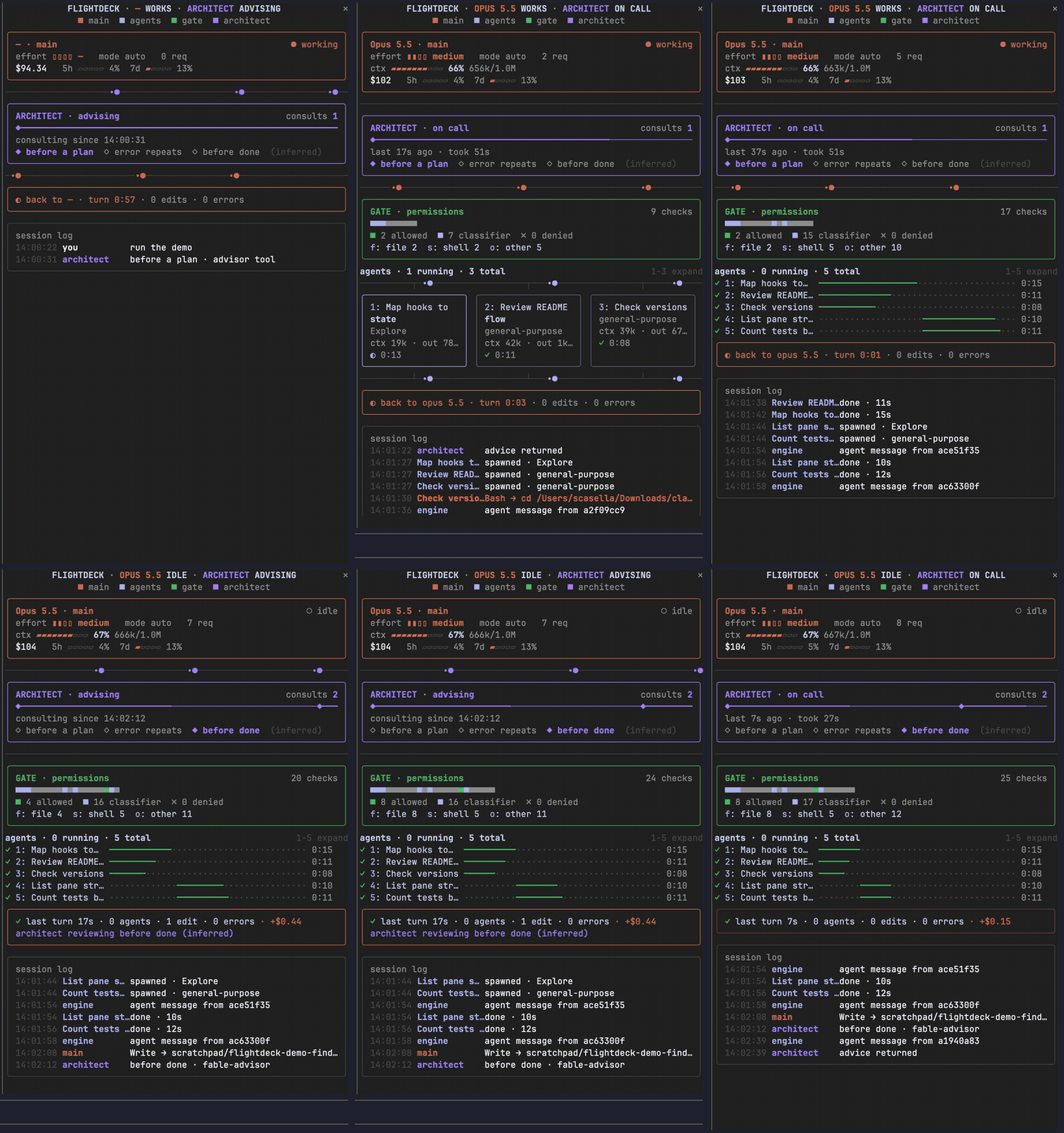
Recorded from Claude Code's interactive UI with the guard loaded. A scripted local API stands in for Claude, so the sessions and token counts are staged and no usage is spent. Every question on screen is the guard's own. Rebuild it from the Northstar fixture.
It acts before the spend, not after it: before an agent starts, a prompt is sent, or a tool call runs. Agent limits hold across every Claude Code session on your machine, and fan-out and heavy context are capped at any usage level, not only near the limit. When you are at the keyboard it asks you, in Claude Code's own question dialog. When nobody can answer, it refuses and tells Claude why, so the model can wait, batch the work, or stop. /agent-guard report shows what it did.
- Plan-aware. It reads the 5-hour and weekly percentages Claude Code reports, and keeps the end of the window for you.
- One answer covers a while. An approval lifts its condition until it clears or times out, so the same question does not come back call after call.
- Local and privacy-minimal. No network, no processes. It stores counts and coarse buckets, never prompt text, tool inputs or model output.
- Fails open. If one of its hooks fails, the event goes ahead: a broken guard never breaks your session. The one exception is an agent it could not judge, which is refused so that Claude starts it again.
Install
Run these commands inside Claude Code v2.1.287 or later:
/plugin marketplace add rbartoli/agent-usage-guard
/plugin install agent-usage-guard@agent-usage-guard
/reload-plugins
Then run /agent-guard to see what it sees, and /agent-guard simulate concurrency to see the question it asks when too many agents run, with nothing held or spent. Mods are on by default; the overview lists the settings that turn them off.
Why this exists
One afternoon I gave Claude Code a research prompt at max effort. It spawned 394 subagent calls, 341 of them running at once, and pushed 84M context tokens through the API in ten minutes. Session over: "Claude usage limit reached." Locked out until the window reset.
That wasn't a one-off. Sixty days of my own logs held 12 lockouts and 166 ten-minute windows with agent bursts. The failure mode multiplies: a large context × rapid tool loops × parallel agents × blind retries. Each protection below removes one factor.
And it's not just me: 339 subagents from a single prompt, half a weekly Max plan consumed by recursive spawning, and multi-agent runs using ~15× the tokens of a chat session.
What it does
| Area | Rule | Default | What happens |
|---|---|---|---|
| Plan windows | New agents need approval once a window is this full | 80% | asks; approval lasts until that window resets |
| New agents are refused once a window is this full | 95% | refuses | |
ScheduleWakeup and CronCreate are refused once a window is this full, so no turn starts itself into the limit | 95% | refuses | |
| Each session is told once to finish its step and say what is left | 95% | adds a note to the next prompt | |
| New agents need approval when the 5-hour window rises this fast | 20 points / 10 min | asks | |
| New agents need approval when the 5-hour window's pace over the last 10 minutes would fill it within the hour, before it resets | at least 2 points over 2 min | asks | |
| Agents | Agents running at once, across every session on this machine | 4 | asks |
| Agents started or resumed per 10 minutes, across this machine | 12 | asks | |
| Tokens processed by subagents per 10 minutes, across this machine; an approval lasts an hour | 10M | asks | |
| Subagents may not start their own agents | depth 1 | refuses | |
| Context | Claude is told once to keep the turn bounded | 300k tokens | adds a note to the prompt |
| A prompt that would re-read this much context | 500k tokens | asks: compact then send, send anyway, or cancel | |
| Tool calls per 10 minutes while a conversation or agent carries this much | 20 calls at 400k | asks: keep going, compact after this turn, or stop | |
| A heavy session idle long enough for its prompt cache to expire | 150k tokens, 1 h idle | asks before re-writing the cache | |
| Loops | The same tool call failing again and again, with no other call in between | 3 identical failures | refuses the identical retry |
| Refused agent calls within 10 minutes | 5 | pauses agent spawns for 10 min |
Agents covers subagents, agent-team teammates, workflow agents, and finished subagents resumed with SendMessage. Haiku agents stay out of the running and starts limits, whether Claude asks for Haiku or the agent's own definition picks it; they still count toward the subagent token budget and every plan-window rule. Each tool call is judged on the context of the loop that makes it, so a small subagent never inherits the main conversation's size.
When it asks. The question appears in Claude Code's own dialog, the one Claude uses to ask you something, and the call waits for your answer. Agents started in parallel while it is open are held back, and Claude starts them again once you answer. If you allow it, that condition stays allowed for a while: a plan window until it resets, a heavy context until it shrinks (for tool calls, an hour at most), the agent counts for 10 minutes. If you decline or dismiss the question, or it closes without an answer for any other reason, Claude is told not to start agents for the next 10 minutes (AGENT_GUARD_WINDOW_SECONDS), and is not asked again in that time. Typed words reach Claude, so you can answer "use haiku agents instead".
When nobody can answer. In claude -p, the Agent SDK and dontAsk mode, an agent or tool gate refuses instead of asking. A heavy prompt is held with the reason, and so is a dormant heavy resume once the machine-wide cap of one per 10 minutes is reached. Prompts that start a turn on their own, such as a schedule or /loop firing, a message relayed from a channel like Slack, or a Slack ping, are held the same way, even in a session someone could be asked in; they never lift limits. Claude reads each refusal as the tool's result. Repeat refusals of the same condition are worded differently each time and escalate: the second says nothing has changed and to try something else, the third says to end the turn. If a Stop hook such as /goal keeps reopening the turn, the refusal says the user has to decide.
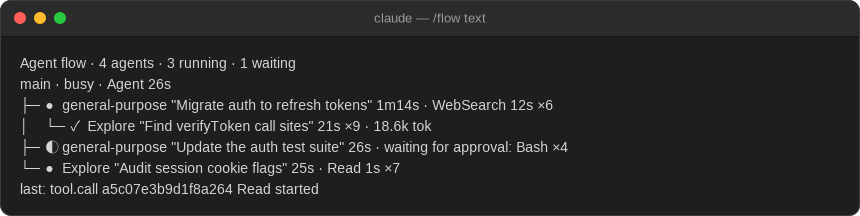
What it shows. While agents run on this machine, or the guard is holding or has just refused something, a line above the prompt shows it: Usage guard · 3 of 4 agents running · 5 of 12 started in the last 10 min · last refusal 14:22: concurrency. It is bold once a limit is reached or something is held, and gone when there is nothing to say. Claude Code's [-] beside it collapses it. Plan windows and context stay in the status line.
What it leaves alone. It never holds a background task's notification or another session's message, because that would lose the result. It no longer blocks prompts after a usage limit: since v2.1.234, Claude Code waits at a limit and continues at reset on its own (autoContinueAtUsageLimit). The guard's job is to keep you from reaching the limit, and its journal counts the lockouts it did not prevent. Near the limit it only adds a note: from 95%, each session's next prompt tells Claude to finish the step in progress, start nothing large, and end the turn with what is done and what is left, so a lockout finds every session at a clean stop.
Idle compaction. Since v2.1.299, Claude Code compacts a conversation of 200k tokens or more that sits idle for about 54 minutes, before its one-hour prompt cache expires (idleCompaction, on by default). The guard reads the compacted size, so it does not ask about that session. Since v2.1.314 it also runs in VS Code and Claude Desktop's Code tab, for subscribers with telemetry turned off, and on Bedrock, Vertex, Foundry and LLM gateways once the one-hour prompt cache is on. Its dormant question covers what idle compaction leaves out: conversations from 150k to 200k tokens, claude -p and SDK sessions, a machine that was asleep at the 54-minute mark, and setups with idle compaction or auto-compaction turned off.
Claude Code's own resume warning. Since v2.1.304, on Pro and Max plans, Claude Code warns before resuming an inactive conversation, or sending to one whose cache went cold while idle, when that would use a noticeable share of your 5-hour limit: you resume anyway or start a new conversation. It shows only from a minimum share, which Anthropic sets per plan and model, so for most models it shows only on very large conversations. The guard's dormant question asks from 150k tokens, so it still covers most cold resumes, and on the largest you may see both.
Commands
/agent-guard [status]                          what the guard sees right now
/agent-guard allow [agents|context] [minutes]  lift its limits for this session (default: all, 10 min)
/agent-guard pause [minutes]                   the same as allow, for every limit
/agent-guard resume                            end an allow early, lift the agent pause, and let declined questions ask again
/agent-guard report [days]                     what it did on this machine (default: 7 days)
/agent-guard simulate <rule>                   show what a rule does, with nothing held or spent
/agent-guard help                              these commands
/agent-guard runs at once, even mid-turn, and never starts a model turn, so Claude never sees an override and cannot take one as permission. Only you can lift limits: when another plugin runs /agent-guard allow or pause, the guard refuses and says so in the transcript. Sending [allow-usage-guard] or [allow-agent-burst] alone as a prompt, the markers of earlier versions, does the same as /agent-guard allow or allow agents.
What it can and cannot see
Checked against Claude Code v2.1.316:
| Path | Coverage |
|---|---|
| Subagents, teammates and workflow agents | Held before they start (agent.spawn) |
A finished subagent sent new work with SendMessage | Held before it resumes, and counted as a start, once |
| A teammate brought back from disk (Claude Code 2.1.299 or later) | Held before it resumes, and counted as a start |
/subtask forks, and anything else that starts without agent.spawn | Counted when they start, never held: Claude Code offers no event before they do. Forks Claude starts through the Agent tool are held like any agent |
| Claude Code's internal agents (prompt suggestions, compaction) | Not counted |
| Plan-window percentages | From the last API response on a subscription, in claude -p too. API-key sessions report none, so only the token and count budgets apply |
| Teammates running in their own terminal panes | Not visible: their loops run in other processes |
| Sessions on other machines | Not counted: the cross-session records live in this machine's mod store |
| Tools the API runs itself, such as the advisor | Not holdable: no tool event fires for them |
Mods run in claude in a terminal, in the Desktop app's Code tab, in claude -p and the Agent SDK. They don't run in a Desktop-app WSL session (where mods run).
On Team and Enterprise plans, and on machines with managed settings, Claude Code runs its built-in cc-plugin-sec-default plugin ahead of every other, unless managed prependPlugins leaves it out. That plugin sends Claude Code's classic hook events on past user plugins, and Claude Code shows a line for each of the guard's it skipped, such as "agent-usage-guard: its classic.PostToolUse hook was skipped". The guard follows compactions, lockouts, /clear and resumes, and Stop hooks that reopen a turn through events that still reach it. Two things need the classic events: the permission mode reaches the guard only when an agent starts, so it may ask you in dontAsk mode, and /subtask forks go uncounted.
Native limits still matter. Claude Code caps a session at 20 concurrent subagents (CLAUDE_CODE_MAX_CONCURRENT_SUBAGENTS) and three layers of nesting (CLAUDE_CODE_MAX_SUBAGENT_SPAWN_DEPTH). It has no limit on the total number of agents a session starts. Since v2.1.316, CLAUDE_CODE_SUBAGENT_EFFORT sets the effort subagents run at when nothing else names one, instead of the session's: a lower one makes each agent cheaper, and the guard still limits how many run. The guard's defaults are stricter and span sessions; the native caps remain the outer wall for the paths the guard only counts.
See what it did
/agent-guard report 30
The report counts usage-limit lockouts (each locked window once), plan-window threshold crossings, wind-down notes, and every question and refusal by rule, with what you answered. It reads every session's journal on this machine and never leaves it. Set AGENT_GUARD_JOURNAL=0 to stop recording.
Security and privacy
A mod runs inside Claude Code with your permissions; read what a mod can reach before you install one. This one is about 3,000 lines of TypeScript with no dependencies, and claude plugin validate . lists every API it calls and every environment variable it reads:
- It makes no network requests and starts no processes. The only file it reads is its own
plugin.json, for the version/agent-guard statusshows. - It decides only what the rules above describe: whether an agent starts, a prompt is sent, or a tool call runs. It asks you whenever you can answer, and gives the reason when it refuses. It reads permission modes but never changes them, and it writes no settings.
- The only prompt it submits is your own. After "Compact, then send", it takes the prompt you typed out of the input box and sends it unchanged once compaction finishes, or puts it back if compaction fails. A prompt with an image or an @ mention stays in the input box for you to send, since a resend would drop them.
- Its prompt hook passes your prompt on unchanged, adds a one-time note for Claude when the context passes 300k or a plan window reaches 95%, or holds the prompt to ask you first (when nobody can answer, it says why instead). Its
SessionStarthook changes nothing. - It keeps its state in the mod store, a JSON file under
~/.claude/plugins/store/. Each session writes its own counts (running agents, recent starts and dormant resumes, subagent tokens per minute, its latest 5-hour reading), when it was last active (kept 30 days, so a resumed session knows how long it sat idle), and its journal rows (time, a session-id prefix, rule, tool name, context bucket such as400-500k, plan window and percentage, refusal number, and your answer). Each record is stored under the session's full id, which is also the name of that session's transcript file. If the store stops saving, such as when it is full, the status line says so: other sessions then stop counting this one. - It never stores prompt text, tool inputs, error text or model output. When a turn ends on an API error, it reads the conversation's last message, the error Claude Code showed, to tell a usage-limit lockout from other failures. A tool call is reduced to a 13-character fingerprint. Agent names stay in memory and are never written.
- Journal days older than 90 days are deleted (
AGENT_GUARD_JOURNAL_DAYS). demo/, which builds the GIF above, is not part of what runs. It starts Claude Code in a temporary home directory with a made-up API key for a scripted local API, and reads none of your credentials.
Set AGENT_GUARD=0 to turn it off without uninstalling it.
Configuration
Set these as environment variables, or under env in ~/.claude/settings.json. Times are in seconds; a value that isn't a number in range keeps its default, and /agent-guard says so.
| Variable | Meaning (default) |
|---|---|
AGENT_GUARD | 0, false, off or no turns the guard off (1) |
AGENT_GUARD_JOURNAL | 0 stops the journal (1) |
AGENT_GUARD_HAIKU_EXEMPT | 0 counts Haiku agents in the running and starts limits like any other (1: they stay out) |
AGENT_GUARD_JOURNAL_DAYS | Days of journal kept (90) |
AGENT_GUARD_WINDOW_SECONDS | Rolling window for budgets, burn and refusals (600) |
AGENT_GUARD_AGENT_MAX | Agents running at once on this machine (4) |
AGENT_GUARD_ROLLING_MAX | Agent starts and resumes per window on this machine (12) |
AGENT_GUARD_AGENT_TOKENS_MAX | Subagent tokens per window on this machine (10000000) |
AGENT_GUARD_DEPTH_MAX | Agent layers below the main conversation (1) |
AGENT_GUARD_LIMIT_ASK_PERCENT | Plan-window percentage from which new agents ask (80) |
AGENT_GUARD_LIMIT_DENY_PERCENT | Plan-window percentage from which new agents, wakeups and scheduled jobs are refused and each session is told to wind down (95) |
AGENT_GUARD_BURN_PERCENT | 5-hour-window points per window that make new agents ask (20) |
AGENT_GUARD_CONTEXT_WARN | Context at which Claude is told once to keep the turn bounded (300000) |
AGENT_GUARD_CONTEXT_HARD | Context at which a prompt asks before it is sent (500000) |
AGENT_GUARD_TOOL_CONTEXT | Context above which tool calls count against the tool budget (400000) |
AGENT_GUARD_TOOL_MAX | Tool calls per window above that context (20) |
AGENT_GUARD_DORMANT_SECONDS | Idle time after which a heavy session's cache counts as expired (3600) |
AGENT_GUARD_DORMANT_CONTEXT | Context at which an idle session counts as heavy (150000) |
AGENT_GUARD_DORMANT_MAX | Heavy dormant resumes per window on this machine when nobody can be asked (1) |
AGENT_GUARD_TOOL_FAILURE_MAX | Identical failures before the identical retry is refused (3) |
AGENT_GUARD_FUSE_MAX | Refused agent calls per fuse period that pause spawns (5) |
AGENT_GUARD_FUSE_SECONDS | The fuse period, and how long the pause lasts (600) |
AGENT_GUARD_PEER_TTL_SECONDS | How long another session's counts, or an agent with no sign of activity, still count (900) |
The dormant default assumes the one-hour prompt cache that subscriptions get within plan usage. With an API key or extra usage, the cache lasts five minutes, so set AGENT_GUARD_DORMANT_SECONDS=300.
Beyond Claude Code
The rules live in a harness-agnostic core (core/) that performs no I/O. The Claude Code mod is its first adapter. docs/architecture.md describes the contract an adapter keeps and what another agent harness must offer to carry each rule.
Tests
claude plugin validate . --strict
claude plugin test
claude plugin test runs the suite inside Claude Code's own test kit: unit tests of the core, and tests that fire real Claude Code events through the hooks module with no session, model or network. TESTING.md covers the layers and what each test proves.
License
MIT
Details
- Author
- @rbartoli
- GitHub Stars
- 103
- Sub-category
- Security
- License
- MIT
- Surfaces
- terminal
- Added
- 4 months ago
- Last synced
- today
- Events hooked
session.startclassic.SessionStartclassic.UserPromptSubmitclassic.PostToolUseclassic.PostCompactclassic.SubagentStartclassic.StopFailuresession.endsession.measureturn.stepturn.completeprompt.submit
Weekly Mods Digest
Top new Claude Code mods and install commands, once a week. No fluff, unsubscribe anytime.